Tuesday, 20 November 2012

Arcade - Tapper

Arcade
Tapper

You look back at arcade games of 1983, and you'll remember just how basic the graphics normally were... and then you look at something like Tapper or Timber by Bally Midway. Alright, Dragon's Lair was around then too, but that's a laserdisc game and not a real arcade game in comparison.

Anyway, the point I was making was that compared to arcade games like, for example, 10-Yard Fight, the graphics on Bally Midway's games was the equivalent of High-Definition TV these days. Not only were the graphics top-notch, but the arcade cabinet was slightly unusual too, featuring a foot rail in the style of a real bar itself, and beer taps along with a joystick for controlling the game. Yes, ACTUAL BEER TAPS.

As the server of drinks, you're required to keep the many and varied thirsty punters adequately watered by filling and flinging drinks down the bars to them. Each screen has four bars for you to keep an eye on, and the simple object is to empty the screen of customers by forcing them back out of the doors by continually supplying drinks. Supplying too many drinks and smashing a glass or letting a punter reach your end of the bar is an instant loss of a life, though.

Sometimes a punter won't go back out the door after one drink, they'll stop and finish their drink and ask for more, flinging the empty glass back in your direction. Again, don't let it fall off the end of the bar, or that'll be another life gone. You can run along the bar to collect empties (or tips), so if time allows that might be a better option.

Collecting tips can be both helpful and fatal for you... as soon as you collect a tip, some form of entertainment will begin in the background. Whatever the entertainment might be, SOME of the punters will be distracted and no longer advance towards you, but they also won't pick up a drink if you sling one in their direction, and, in case you haven't guessed, sending too many drinks down the bar for them to smash against the doors... will cost you a life.

So the odds are certainly stacked against you, but hey, the game's still a lot of fun, and once again, like all the best games, there's some nice little touches in there, like your character's reaction when you complete a level... he'll pour himself a drink (sometimes a few in quick succession), and then throw the glass and smash it on his foot (all of a sudden, breaking a glass is PERFECTLY FINE??), or on his head, or even take a bird out of the sky...

And then there's the bonus level between scenes... The Bandit will shake up 5 of the 6 cans waiting on the bar, not only must you remember which one was NOT shaken, he then mixes them up to make life more fun for you.

The game was originally all about serving beer, obviously, but it also got a family-friendly overhaul as "Root-Beer Tapper", replacing some of the graphics so that the barman now looks like a "Soda Jerker", for example. Obviously the worry was that kids would become alcoholics or something, but as we all know, if video games influenced our behaviour, we'd all be dressing up in yellow costumes, wandering round mazes and eating pills, going "Wakka Wakka Wakka Wakka" all day long.

Hmm. Anyway, to surmise, then: Tapper is a great game that LOOKS way ahead of its time. It's challenging, but it's all good fun. If you're lucky enough to find an original working cabinet, don't waste any time, get your money in and enjoy 80s arcade gaming at its best.

Wednesday, 14 November 2012

ZX Spectrum - Lightgun Action Pack

ZX Spectrum
The Spectrum Light Gun Action Pack

Operation Wolf
Bullseye
Missile Ground Zero
Robot Attack
Solar Invasion
Rookie

The Spectrum Light Gun was an interesting device. Shaped like a weapon that would have looked good on Blake's 7, it was actually quite spiffy as far as light guns went... at least back then, anyway.

Allow me to reminisce for a minute. It's Christmas 1989. I've received my beloved Spectrum. Fairly late to the party, it's a +2A model, and with it comes the  light gun and 6 games. Yes, if you're a regular reader (don't think I have any of those, but it'd be nice), I've told some of this story before, but allow me to bore you further.

The six games are actually all pretty good, really. And all fairly varied, as much as Light Gun Games can be at least. Sure, a few of them might have been subject of some scathing reviews, but what you have to bear in mind is that when these were reviewed at the time, the term "value for money" probably resulted in a great reduction of the scores. This I cannot argue with, when the price of the pack (a princely £30 or so at the time) is taken into account, compared to other compilations such as, for example, Konami Arcade Collection (10 games) or Winners! (5 games) or The Biz (4 games but 3 of them were Your Sinclair Megagames), which usually retailed at around £15... I think you see where I'm coming from.

Anyway, enough yarbling, onto the games.

First up was always going to be the "flagship" arcade conversion, Operation Wolf. Unfortunately, I've already reviewed it, so rather than a feeble copy and paste, I'm simply going to link to that review (which rather handily covers the original arcade game too). So click here and off you go.

Next up was Bullseye. You know Bullseye, staple of Sunday evening TV in the 80s, before Gladiators came along of course. Anyway, based on the hit quiz show (which has had something of a resurgence on Challenge TV in recent years), the gun takes care of the dart throwing (or arrows as they seem to be referred to), but you have to have the keyboard in reach to be able to type your answers quick enough. There doesn't seem to be a massive variety of questions, ones about John Frieda's girlfriend (Lulu) and The Venerable Bede seem to repeat themselves with alarming regularity.

Overall, I personally found this game to be the weak link in the whole package. The targeting sometimes seems way off, you can barely move the gun, fire all 3 darts, and 1 of them will find it's way to the far edge of the screen while the others rest firmly in the treble 20. Because it's not a fast action game, there's no issue with slow-down from firing too much, but still, it remains relatively unexciting compared to the rest.

Next up is Missile Ground Zero. Think "Missile Command", but rather than a trackball and slow missiles, you can target instantly with the gun and shoot at the tiny little things that fall from the sky threatening your cities. Each shot is shown as an explosion on screen, and whilst the white flashes may affect those with photo-sensitive conditions, the action doesn't slow down, and is fast and frantic.

Better still, the game features some of the best music of ALL TIME on the Spectrum. And! AND! AND!! It takes about 45 seconds to load from tape. (Memory fading, but it seemed that way, I know it didn't take long). Sure, it's repetitive and it's basic, but by the hell it's a blast of fun, and for such a quick load, I probably played this game more than any other.

From there, we go to Robot Attack, now this one is a little bit disappointing. Made by the same folks and featuring the same music as Missile Ground Zero (which is a highlight), the game itself is a little bit poor in comparison. Robots walk along the platforms, you have to shoot them a number of times according to what colour they are. Some robots are indestructable, some will collapse when shot, get repaired and come back a different colour. If a robot reaches a crate, they build part of a "Mega-Robot", which, if completed, will spell game over for the human race. Or something. There's power-ups with varying effects, but to be honest, you'll probably play this a couple of times and have had enough by that point.

The final two games in the package are real gems, and more than make up for any disappointment you might have felt by Robot Attack and Bullseye. Which is better? Erm... I couldn't really choose.

First up then, is Solar Invasion. Massive aliens are attacking our Solar System, these massive aliens release little baby aliens that will evolve before your very eyes, eventually becoming equally massive aliens. The object is simple enough... destroy them all before they destroy the human race.

You basically drift around space a bit, aided by a radar to help you find the alien scum, as well as ammo pickups and smart bombs. Shooting the little arrows at the top and bottom of the status panel will rotate your direction accordingly, and, as with all the best simplistic concepts, that is pretty much all you need to know. By the time you reach the last few levels, you'll see just how quickly the aliens evolve, be prepared for some fast and frantic shooting to stand any chance whatsoever of completing the game. I never quite made it.

Rookie is a target shooting game, and a mighty fine one at that. It tests your reactions and accuracy, pitting you against the clock to reach the required score on each level. The action takes place over a number of screens (I think it's about 20, I can't remember), on each one a number of targets will begin to appear, as each one does a number appears on them, beginning at 100 and counting down to 0. Shoot the target too early you'll get no points. The quicker you shoot from the moment 100 is displayed, the more points you get. Ammo is limited, so you can't go crazy.

Fortunately, once the last target has appeared, you'll start getting bonus ammo signs in the corner of the screen. If you have enough time to stock up, you can hang around and shoot these for an extra 10 bullets each time, or you can shoot the arrows to proceed to the next screen, where there will be more targets.

Guess what? ONCE AGAIN, simple concept, simple fun. It works brilliantly and the game caused great competition between me and my family. Which is where this game gets my ultimate seal of approval.

My sister was actually quite good at this game, but she could never put her name in the high score table. Why not? Because as soon as she typed in her name, it replaced it with "Hi there, Smudge Face!" We never understood why. Anyway, the mystery is solved, I emailed a chap called "Equinox" who had a page on Spectrum "Easter Eggs", and told him about that particular incident. Within 24 hours, he'd gone through the game's code and found several other things you could type in on the high score table... only to be replaced by something else. Who "Lynn" is, although the code seems to reveal her surname may be "Fairclough", remains a mystery. But thank you, Peter Gough, for the amusement you provided me and my sister.

Oh, if you want to see the rest of the hidden easter eggs in this game, the page has disappeared from the internet, luckily the World Of Spectrum website has archived it for your pleasure, and you can find it right here. (Warning, this page does contain a few naughty words. You know, like tit, shit and... erm... probably some others.)

(The above review was written with much love to Smudge-Face)

Monday, 8 October 2012

Handheld Games - Tomy Turnin' Turbo Dashboard

Handheld Games
Tomy Turnin' Turbo Dashboard

Hmm. Not technically a hand-held game, but it's small enough, you COULD play it hand held. Despite the 4 'D' size batteries required to run it.

Still, it's a game, it's retro, and it's... well... as a 5 or 6 year old at the time, it was fascinating, but now? It's a hunk of plastic with no real gameplay in there.

Alright, I'm being harsh. Because, despite the fact that it's the shallowest "game" in the world, with very little replay value, young Fishsta would play it over and over again... and my happy memories of playing it as a fascinated youngster come flooding back.

So what do you do... turn the ignition key to turn it on, press the reset button to refill the fuel gauge and turn the "Trip" counter back to zero. Select a gear, and you're away. Your display is a small back-lit rolling roadway with your natty red car at the bottom of the screen. Stay on the road to make the "Trip" counter rise (effectively your score), touching the edges of the road will cause it to stop for a few seconds. And. That's. It. Until your fuel runs out, whereupon you hit the reset button and try again. And again. And again.

The gear stick chooses what speed you go, but after some practice, I'd managed to go at full speed for the entire fuel tank, pretty sure that just about wrapped the Trip Counter back to zero again.

You might see one of these at a Car Boot sale, and if you do, why not offer a couple of quid for a little entertainment?

Just don't expect to be still playing it the next day. I know what I'll be doing is taking it apart to see how the gear lever changed the speed and Revs display. That fascinated me! Simple things, simple minds and all that...

Wednesday, 26 September 2012

Sony Playstation - Bishi Bashi Special

Sony Playstation
Bishi Bashi Special

Some games are just plain insane. Take Warioware, for instance. Complete and utter insanity. Yet a hell of a lot of fun.

Well, years before Warioware first touched our already corrupted brains, Konami had already had considerable success in the "Microgame" market with Super Bishi Bashi and Hyper Bishi Bashi in arcades... and of course, the Playstation version in Bishi Bashi Special.

And yes, it was a collection of mini/microgames, many of which had a distinctly "insane" feel about them. But if I had a choice of WarioWare or Bishi Bashi Special as the only game I can take with me to a Desert Island... I'd choose Bishi Bashi in a heartbeat.

The name of the game is a big clue, many of the minigames require quick reactions or quick bashing to win. Others require a good rhythm. But the emphasis is on the bash of the buttons. That and good clean fun, of course.

So you fire the game up, and first of all you're offered a choice between "Super Bishi Bashi" and "Hyper Bishi Bashi". The real difference between these two is the choice of minigames you'll have when you actually play. Both have their share of gems among the games, but if my life depended upon choosing one over the other, I'd play the Hyper mode.

Whichever you choose, you can either play all the games involved in that particular mode in a Marathon Endurance Challenge, or choose one game at a time.

Each round is fairly straightforward. With a typical Japlish cry of "ATTENTION!", you're given a very brief instruction of what you're about to have to do... and then you're off. Each game can last from between 20 seconds and about a minute, if you're successful you carry on, if you're not, you lose a life. Which is almost exactly how Warioware works, but in 5 second bursts.

And that's it. You get two lives, but seemingly infinite continues, but obviously for big scores you don't want to be using them. All that's left is to describe the games themselves, then...

There's a lot of variation, some games are rhythm based, where you have to copy a rhythm, which is graphically represented by your growing afro (and yes, it can fill the screen), others are reaction based, where you have to hit the right button or sequence of buttons to eat a cake, or beat up some gangsters, or eat beans, or make burgers, or... erm... a whole host of other things.

Some games require you to identify an object as it glides past, possibly obscured, others require you to drive cars or tanks. But there's two games in particular that stand out, and could not be anymore Japlish if they tried.

From Super Bishi Bashi, there's "The Not Too Great Escape". It's kind of like Blind Man's Bluff, there's a guard armed with an assault rifle with his back turned to you, and you must tap the buttons to scuttle across open ground behind him. Numbers flash across the screen as he counts to 10, when he reaches 10, he turns round, and if you're not hiding in your trash can or whatever, you get shot in a hail of gunfire, and must try again. Pure brilliance.

From Hyper Bishi Bashi, there's the "Hyper Pie Throw". It's basically the same as a javelin event in any Track and Field based game ever, bash the buttons to gather speed, then hit the middle button to set the angle, and hope for a good distance. The big difference is... it's set at a wedding. The bride hurls the pie with the groom running along behind, holding her dress up. And the vicar giving it his best "Ready, Go!" that he possibly can. I don't care if it's insane, it's bloody hilarious.

So, it's a rave review, right?

Yes. BUT.

I'm sorry, I love this game, it's great fun, whether on your own or playing with others, but there's just one problem right now. If you download this game from PSN for your PS3, DON'T BOTHER playing the rhythm based games. I don't know what it is, but SOMETHING is amiss in the timing with the joypads. I've tried them wireless, wired, tried adjusting the delay settings, and no, there is no getting away from it. Unless someone else has any bright ideas?

Friday, 7 September 2012

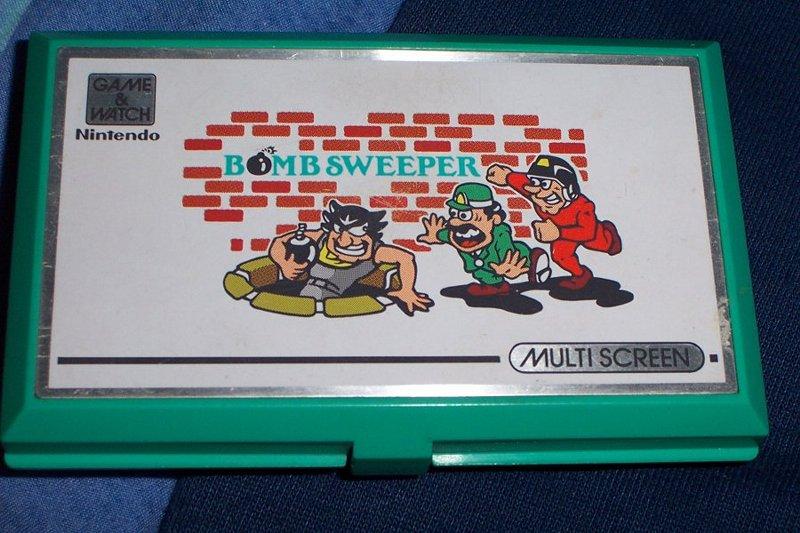
Handheld Games - Bombsweeper

Handheld Games
Bombsweeper

Any retro gamer worth his salt will at the very least be aware of Nintendo's famous Game & Watch range. Most of them will probably own one at the very least. But if you've never heard of them, they're a pretty simple concept: Combine the best parts of LCD-based gameplay with the features of a clock (including an alarm). Except, most LCD-based games were pretty crappy.

Nintendo, however, got some things right... Simple concepts and simple games make successful games. Well, they did back in the good old days.

Bombsweeper was one of the best LCD based games (pre-Gameboy) you could buy. And guess what... it was a simple concept.

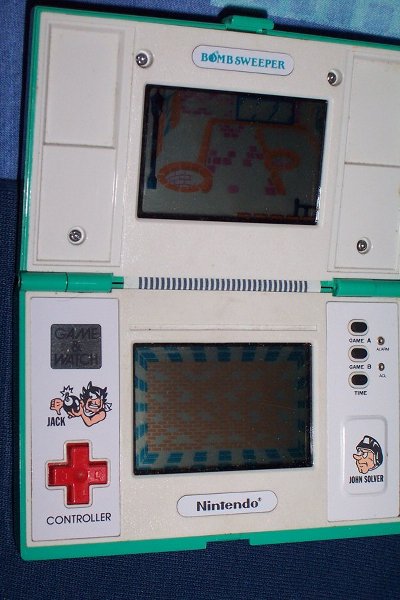
In fact, it's kind of like Pengo or whatever variation of that you like to call it. The naughty Jack has decided for some reason to jump down into the sewer and plant a load of bombs. The policeman on hand is highly useless, but allows John Solver (that's you, by the way) to dive in after him and defuse them all.

The gameplay mechanics are simple enough... reach one of the bombs (hidden in the walls) before time runs out. This may mean negotiating a maze, or it may mean pushing walls around a bit. Simply enough, you can only push a wall if there's no wall obstructing its path. Logic is needed in abundance. The thing to remember is you only need to reach ONE of the bombs, some may just be Red Herrings.

And that really is it. Almost.

There's two variations to the game, Game A is a series of set puzzles with a 40 second time limit. These are much more taxing on the old grey matter, but generally leave you with plenty of time to complete the puzzle and gain points aplenty. Every ten levels you will then face a scrolling level, where you must avoid being crushed by walls as you attempt to reach the end and the one single bomb. No time limits on this bit.

Game B generates mazes in a random order. Each one can be completed rather simply and in a matter of 2-4 senconds. Doesn't sound like a challenge? At first, it isn't. You start off with a 40 second time limit, but this steadily decreases until you're down to just 4 seconds for each level. Oh, yes, this is a d-pad tapping frenzy from one level to the next, with NO let-up whatsoever.

BUT once again, the simple and frantic gameplay pays dividends. It's a marvellous little hand-held game. If you see one at a car boot sale, it's worth a punt. Trust me.

Friday, 10 August 2012

Arcade - Bad Dudes vs DragonNinja

Arcade - Bad Dudes vs. DragonNinja

Sometimes a game brings out the best and the worst in Retro Gaming. Y'see, there's a big difference between playing a game in the way it was meant to be played, and then reliving it years later through an emulator or something. Or at least, it seems that way with me.

If I played an Arcade Game, I'd expect to get as far as I can through it every time. By that I mean, I learned the right tactic to employ to get to a certain point, and that's where I'd try and reach, normally in one credit. Normally, for example, I'd expect to complete Time Crisis 2 with one credit, I'd expect to complete Double Dragon in one credit, I'd expect to get to level 3 of DragonNinja (but only just), and half-way through the first level of Ghosts 'n' Goblins. I was crap at Ghosts 'n' Goblins.

Anyway, on that basis, DragonNinja was great. It was also great in that it brought us one of the earliest and most iconic "Intro sequences" seen in games. "President Ronnie has been kidnapped by the ninjas", you are told. Fantastic, do ninjas tend to take hostages these days? "Are you a bad enough dud to rescue Ronnie"?

Yes. Yes I am.

Except I wasn't. I never got close until MAME came along. And that's where this game suddenly becomes very very bad.

Well, not bad as such, but MAME showed me what I would have had to deal with if I'd ever been brave enough to shove another credit in after I'd reached my "limit". And trust me, it would have meant my next credit would have been over in about twenty seconds. And the next. And... you get the idea.

DragonNinja starts off with enough enemies to cause you problems and test your reactions and control of the game, but not too much to make progress impossible. The game's difficulty really rises with the level 2 boss, and then level 3 becomes almost as ridiculous as a "Bullet Hell Shmup".

So, yes, I've seen the ending (And it's almost as funny as Zangief's ending in Street Fighter II), but I urge you to play the game on one credit, and not spoil what is essentially good, solid fun until you reach that point.

It's a standard two-tier beat 'em-up (you know, you can take a high or a low path and jump between them at any time), but you should be spending most of your time on the top level. Ninjas attack you from all directions, but luckily you have a few sweet moves you can carry out. You know, the usual kicks, punches, fire punches... Erm...

The different attacks are easy enough and obvious enough to pull off. Pressing attack will punch. Combine it with moving the joystick in the opposite way to which you are facing, and you'll perform a rear-kick. Pressing down will allow you to leg sweep. You can even do a spinning flying kick thing. But hold down the attack button for a couple of seconds and your shoulders set on fire, releasing the button will unleash a much more powerful attack which can either cause serious damage to a boss, or take out several single-hit enemies at once. Marvellous.

Some enemies carry weapons, such as swords and throwing stars, others will drop handy weapons like knives and nunchucks (or energy or time). None of which will do you any good come level 3.

Data East, probably best remembered for their awesome arcade version of Robocop, use their typical graphical style to nice effect, but there's one scene fondly remembered by most Arcade Gamers worth their salt... the second level's truck-top fight. If there's no other reason to play Bad Dudes, this level alone is worth your time.

Without being an outstanding game, it's an iconic reminder of games of yesteryear.

Thursday, 9 August 2012

The Best in Copy Protection

The Best in Copy Protection

Y'know, I remember the good old days. When games were nice and cheap and no-one really copied them. Well, they did, of course, but not in the same way they are now. Y'see, one of the most valid arguments pro-piracy (and believe me, I'm NOT pro-piracy, I just agree with this particular train of thought that games are too expensive, and that encourages piracy) is that each copied game is not REALLY a lost sale, it's a sale the developer was never going to have, and instead they get free word-of-mouth advertising if their game is really good. It's a weak argument, sure, but it's one that makes me think, "The Pirates have a point".

Anyway, my point of view is that if a product is worth buying, and I can afford it, I'll support it. I've done it with Shareware, and had no complaints about doing it. So, if a developer comes up with something novel or interesting to frustrate pirates, then I'm all for it.

Back in the day, the simplest forms of Copy Protection were a case of "Look up the first word on line x of page y". It wasn't much, but it was enough. Obviously the photocopier helped to circumvent that particular form of protection, although in those days a photocopier wasn't quite so easy for Joe Public to find. Things developed over the years... Who can forget Lenslok? Then Code Wheels were introduced (games like Zool and Monkey Island probably most famously), and code books printed on paper designed to be impossible to photocopy (e.g. Worms)

But as things progress, things get more sophisticated. Games became able to detect themselves whether they had been been pirated, or even at risk of being pirated, and refused to run... or perhaps even stranger effects.

Let's also not forget that anti-piracy methods also introduced us to the first PC Virus, the Pakistani Brain virus. Designed to protect a heart-monitoring program from piracy, (or rather track it) it soon spread to the UK and US. It didn't actually do any damage, thankfully, but still people rang the programmers asking for their computers to be "vaccinated" in their thousands.

So here are my favourite anti-piracy or copy protection schemes, and some of them I'd actually really like to see in action.

Code Sheet - Jet Set Willy (Spectrum), Worms (Amiga)
The code sheet was nothing more than a list of numbers (or in JSW's case, Colours), an entry from which would be required on loading the game. Simple, quick and downright straightforward to circumvent by copying the code sheet. Worms made life harder by printing it black-on-black so that you couldn't very well photocopy it, but a dab hand at Excel could copy it within an hour or so.


It's pretty obvious how this works... The game requests the code from Column A, Row X, you look it up and type it in. JSW provides you with a key to the colours and what numbers they represent, which is nice.

Not much more can be said about this. It's as basic as it gets.


Code Wheels - e.g. Zool, Monkey Island (Amiga)
Designed to be overly complicated to copy, Code Wheels were actually a pretty simple concept. The game will show you a picture or something, made of two distinct halves. Take your code wheel, turn it to make that picture. Then read the code from the indicated window. Tap it in, and joy! Your game runs. Get it wrong, and you'll probably get another chance. Get it wrong again and the game will probably reset itself. Annoying, huh? And since the windows are all over the place, it's not so straightforward to calculate their positions. Genius! Oh, did I mention the black-on-black writing used for Zool? Impossible to read! Wahey! At least it was impossible to photocopy.

Actually, not everyone had the foresight to use black-on-black, Lucasarts' code wheels for the Monkey Island games, for instance. 15 Photocopies is all you need. Not something that would put off the serious pirate.

Again, though, this wasn't going to STOP piracy, just discourage it slightly. Anyone with patience could actually copy the numbers in a spreadsheet, if they were that determined to copy a game.


Lenslok - OCP Art Studio (Spectrum)
Ah, one of those things that always gets the little "TM" after its name. I might change my name to Fishsta(TM). Ahem.

Anyway, I remember my mum deciding it would be a good idea to get me a mouse and Art Program for the Spectrum. And you know what, it wasn't bad. But it introduced me to what was probably the best copy protection system I'd ever seen. No, really.

You ask any Retro-head about Lenslok, and they'll tell you what a stupid, crap, unreliable system it was. I personally never had a problem with it, and I found it GENIUS. Take a look in this box here, and you'll notice the red thing. That's the Lenslok "lens".

So, you load your game/art software up, and then you are presented with the first stage of the protection... measuring your lenslok. No, really. You hold the thing up to the screen (fully unfolded) against a large letter "H", and using a couple of keys on the keyboard, adjust the width of it until it matches the length of your Lenslok. Press Enter to move onto the next stage, the "dry run test" stage.

Now you fold the Lenslok so that it resembles a map-reading magnifier. Hold it against the screen, centered on the middle of the "H". The plastic bit in the middle acts like a prism, distorting your view of that portion of the screen. If you look at the screen without the Lenslok, you'll just see a garbled mess, the distorted view through the Lenslok actually makes sense of it, and you should be able to read 2 letters, at this point they should be "O" and "K". Once you're happy with that, keep the Lenslok in place and press enter. Two new letters appear, type them in, and off you go.

So, what were the problems? Well, the idea of measuring your lenslok on the screen was so that the size of your TV or monitor wasn't a problem, but with the limited resolution of home computers, sometimes it was. And, of course, constantly bending plastic back and forth will eventually break it, even if that's what it was designed to do.

It sounds as though I was lucky, really.


Modern day In-Built Copy/Crack detection - Having fun with the Pirates!
Now for my FAVOURITE part. You've done what you can to stop piracy, and it still happens. It always will. It's never going to stop. So make it a game itself, then. Mess with the pirates heads, annoy them, frustrate them, do whatever you can to delay "Day Zero" hacked versions appearing.

It's been going on for a while. Just ask anyone who knows their stuff about Spyro or Earthbound. These used multi-layered protection which worked so that the game would detect unauthorised copies at several points, and cause undesirable operation throughout the game. The game lets you know right away that it knows it's copied (Spyro actually tells you outright, "I'm sorry, Spyro, but you seem to be playing a hacked version of this game..." it really couldn't be any clearer) but crackers persisted and EVENTUALLY beat all the layers, which would include surprises like more and tougher enemies, settings changes and even the famous "crash and delete your savegames" trick.

I could go into great detail about all these, but they've been written about elsewhere and a quick search on Google will find you plenty of in-depth information. But I take great delight in those measures that leave pirates confused as to whether it's a problem with the game or deliberate protection by the developers. Very quickly, here are some of my favourites that I've recently heard about:

Michael Jackson: The Experience (DS)
What could be worse than a generic dancing game cashing in on Michael Jackson's awesome music and dancing skills? How about getting into a game to be treated to the sound of the Vuvuzela over the soundtrack? Yeah, that'll put the pirates off, more than replacing all songs with DJ Otis' "Hey Baby!"

Batman: Arkham Asylum (PC)
But... but... I am BATMAN. I cannot have my abilities taken away, surely? If you're a pirate, yes, you'll lose the ability to Bat Glide. Since there's parts of the game where you HAVE to glide to survive, you'll only get so far before you hit a brick wall. And the best bit? Someone posted on a forum about the problem they were having, only to be told outright, "It's not a bug in the program code, it's a bug in YOUR moral code". Awesome.

ARMA2 (PC)
This one I'd really like to see. Apparently, a new technology called "FADE" was introduced, which basically SLOWLY broke the game. It started messing with the camera, and lowering your weapon's accuracy and power, until eventually they were as useless as pea-shooters. And finally, you get a message, "Original Discs don't FADE". It sounds pretty cool.

Serious Sam 3: BFE (PC)
I have to take my hat off to this one, this is brilliance. And again, this is one I want to EXPERIENCE. The game plays as normal... for about 30 seconds. Just after you collect your first gun, you run into what is now known as the "DRM Scorpion".

This guy looks mean, and is armed with tough claws and twin machine guns. He's fast, too, about 5 times as fast as you. Basically, there's no escape from him, so maybe you should face him head on and kill him before he kills you...

Nope, that doesn't seem to work. Maybe a game of cat and mouse, in and out of cover, get as many hits in as you can?

Maybe you should stop wasting your time, pirate. The DRM Scorpion is immortal. He will persist in chasing you until he kills you. Although apparently you can get through the first couple of levels, the difficulty curve isn't just steep, it's vertical.

Don't worry, though. Even the best gameplayers will get stuck when the second protection system kicks in... all of a sudden you'll look up to the sky and start spinning on the spot. Meanwhile, any bad guys in the area will take this oppurtunity to kill you.

Is that the last of the protection systems? Maybe... maybe not. But the Scorpion alone sounds too awesome to miss. The regrettable thing is that it's tempting for even a non-pirate to pirate the game just to see it. This must be one of the rare occasions where the pirates get more content than the people who hand their money over for a legitimate copy. Maybe not such a wise move?