Thursday, 9 August 2012

The Best in Copy Protection

The Best in Copy Protection

Y'know, I remember the good old days. When games were nice and cheap and no-one really copied them. Well, they did, of course, but not in the same way they are now. Y'see, one of the most valid arguments pro-piracy (and believe me, I'm NOT pro-piracy, I just agree with this particular train of thought that games are too expensive, and that encourages piracy) is that each copied game is not REALLY a lost sale, it's a sale the developer was never going to have, and instead they get free word-of-mouth advertising if their game is really good. It's a weak argument, sure, but it's one that makes me think, "The Pirates have a point".

Anyway, my point of view is that if a product is worth buying, and I can afford it, I'll support it. I've done it with Shareware, and had no complaints about doing it. So, if a developer comes up with something novel or interesting to frustrate pirates, then I'm all for it.

Back in the day, the simplest forms of Copy Protection were a case of "Look up the first word on line x of page y". It wasn't much, but it was enough. Obviously the photocopier helped to circumvent that particular form of protection, although in those days a photocopier wasn't quite so easy for Joe Public to find. Things developed over the years... Who can forget Lenslok? Then Code Wheels were introduced (games like Zool and Monkey Island probably most famously), and code books printed on paper designed to be impossible to photocopy (e.g. Worms)

But as things progress, things get more sophisticated. Games became able to detect themselves whether they had been been pirated, or even at risk of being pirated, and refused to run... or perhaps even stranger effects.

Let's also not forget that anti-piracy methods also introduced us to the first PC Virus, the Pakistani Brain virus. Designed to protect a heart-monitoring program from piracy, (or rather track it) it soon spread to the UK and US. It didn't actually do any damage, thankfully, but still people rang the programmers asking for their computers to be "vaccinated" in their thousands.

So here are my favourite anti-piracy or copy protection schemes, and some of them I'd actually really like to see in action.

Code Sheet - Jet Set Willy (Spectrum), Worms (Amiga)
The code sheet was nothing more than a list of numbers (or in JSW's case, Colours), an entry from which would be required on loading the game. Simple, quick and downright straightforward to circumvent by copying the code sheet. Worms made life harder by printing it black-on-black so that you couldn't very well photocopy it, but a dab hand at Excel could copy it within an hour or so.


It's pretty obvious how this works... The game requests the code from Column A, Row X, you look it up and type it in. JSW provides you with a key to the colours and what numbers they represent, which is nice.

Not much more can be said about this. It's as basic as it gets.


Code Wheels - e.g. Zool, Monkey Island (Amiga)
Designed to be overly complicated to copy, Code Wheels were actually a pretty simple concept. The game will show you a picture or something, made of two distinct halves. Take your code wheel, turn it to make that picture. Then read the code from the indicated window. Tap it in, and joy! Your game runs. Get it wrong, and you'll probably get another chance. Get it wrong again and the game will probably reset itself. Annoying, huh? And since the windows are all over the place, it's not so straightforward to calculate their positions. Genius! Oh, did I mention the black-on-black writing used for Zool? Impossible to read! Wahey! At least it was impossible to photocopy.

Actually, not everyone had the foresight to use black-on-black, Lucasarts' code wheels for the Monkey Island games, for instance. 15 Photocopies is all you need. Not something that would put off the serious pirate.

Again, though, this wasn't going to STOP piracy, just discourage it slightly. Anyone with patience could actually copy the numbers in a spreadsheet, if they were that determined to copy a game.


Lenslok - OCP Art Studio (Spectrum)
Ah, one of those things that always gets the little "TM" after its name. I might change my name to Fishsta(TM). Ahem.

Anyway, I remember my mum deciding it would be a good idea to get me a mouse and Art Program for the Spectrum. And you know what, it wasn't bad. But it introduced me to what was probably the best copy protection system I'd ever seen. No, really.

You ask any Retro-head about Lenslok, and they'll tell you what a stupid, crap, unreliable system it was. I personally never had a problem with it, and I found it GENIUS. Take a look in this box here, and you'll notice the red thing. That's the Lenslok "lens".

So, you load your game/art software up, and then you are presented with the first stage of the protection... measuring your lenslok. No, really. You hold the thing up to the screen (fully unfolded) against a large letter "H", and using a couple of keys on the keyboard, adjust the width of it until it matches the length of your Lenslok. Press Enter to move onto the next stage, the "dry run test" stage.

Now you fold the Lenslok so that it resembles a map-reading magnifier. Hold it against the screen, centered on the middle of the "H". The plastic bit in the middle acts like a prism, distorting your view of that portion of the screen. If you look at the screen without the Lenslok, you'll just see a garbled mess, the distorted view through the Lenslok actually makes sense of it, and you should be able to read 2 letters, at this point they should be "O" and "K". Once you're happy with that, keep the Lenslok in place and press enter. Two new letters appear, type them in, and off you go.

So, what were the problems? Well, the idea of measuring your lenslok on the screen was so that the size of your TV or monitor wasn't a problem, but with the limited resolution of home computers, sometimes it was. And, of course, constantly bending plastic back and forth will eventually break it, even if that's what it was designed to do.

It sounds as though I was lucky, really.


Modern day In-Built Copy/Crack detection - Having fun with the Pirates!
Now for my FAVOURITE part. You've done what you can to stop piracy, and it still happens. It always will. It's never going to stop. So make it a game itself, then. Mess with the pirates heads, annoy them, frustrate them, do whatever you can to delay "Day Zero" hacked versions appearing.

It's been going on for a while. Just ask anyone who knows their stuff about Spyro or Earthbound. These used multi-layered protection which worked so that the game would detect unauthorised copies at several points, and cause undesirable operation throughout the game. The game lets you know right away that it knows it's copied (Spyro actually tells you outright, "I'm sorry, Spyro, but you seem to be playing a hacked version of this game..." it really couldn't be any clearer) but crackers persisted and EVENTUALLY beat all the layers, which would include surprises like more and tougher enemies, settings changes and even the famous "crash and delete your savegames" trick.

I could go into great detail about all these, but they've been written about elsewhere and a quick search on Google will find you plenty of in-depth information. But I take great delight in those measures that leave pirates confused as to whether it's a problem with the game or deliberate protection by the developers. Very quickly, here are some of my favourites that I've recently heard about:

Michael Jackson: The Experience (DS)
What could be worse than a generic dancing game cashing in on Michael Jackson's awesome music and dancing skills? How about getting into a game to be treated to the sound of the Vuvuzela over the soundtrack? Yeah, that'll put the pirates off, more than replacing all songs with DJ Otis' "Hey Baby!"

Batman: Arkham Asylum (PC)
But... but... I am BATMAN. I cannot have my abilities taken away, surely? If you're a pirate, yes, you'll lose the ability to Bat Glide. Since there's parts of the game where you HAVE to glide to survive, you'll only get so far before you hit a brick wall. And the best bit? Someone posted on a forum about the problem they were having, only to be told outright, "It's not a bug in the program code, it's a bug in YOUR moral code". Awesome.

ARMA2 (PC)
This one I'd really like to see. Apparently, a new technology called "FADE" was introduced, which basically SLOWLY broke the game. It started messing with the camera, and lowering your weapon's accuracy and power, until eventually they were as useless as pea-shooters. And finally, you get a message, "Original Discs don't FADE". It sounds pretty cool.

Serious Sam 3: BFE (PC)
I have to take my hat off to this one, this is brilliance. And again, this is one I want to EXPERIENCE. The game plays as normal... for about 30 seconds. Just after you collect your first gun, you run into what is now known as the "DRM Scorpion".

This guy looks mean, and is armed with tough claws and twin machine guns. He's fast, too, about 5 times as fast as you. Basically, there's no escape from him, so maybe you should face him head on and kill him before he kills you...

Nope, that doesn't seem to work. Maybe a game of cat and mouse, in and out of cover, get as many hits in as you can?

Maybe you should stop wasting your time, pirate. The DRM Scorpion is immortal. He will persist in chasing you until he kills you. Although apparently you can get through the first couple of levels, the difficulty curve isn't just steep, it's vertical.

Don't worry, though. Even the best gameplayers will get stuck when the second protection system kicks in... all of a sudden you'll look up to the sky and start spinning on the spot. Meanwhile, any bad guys in the area will take this oppurtunity to kill you.

Is that the last of the protection systems? Maybe... maybe not. But the Scorpion alone sounds too awesome to miss. The regrettable thing is that it's tempting for even a non-pirate to pirate the game just to see it. This must be one of the rare occasions where the pirates get more content than the people who hand their money over for a legitimate copy. Maybe not such a wise move?

Friday, 13 July 2012

Commodore Amiga - Rampart

Commodore Amiga
Rampart
Take yourself back to medieval times, when battles were fought by the firepower of cannons from castles and ships, where warriors invaded the coasts to take over the first available stronghold and attempt to work their way over land, looting and pillaging and sacking along the way.

Sounds pretty sweet, huh? Well, actually, Rampart is a pretty sweet game, and it's one of those you can just pick up and play without too much hassle. In fact, that's exactly what you should do. Right now.

OK, it wouldn't be much of a review if I wrote that and signed off at this point, so I guess I should try and sell this to you. The concept is simple. Retain at least one castle after each round of battle to stay alive. To retain a castle, it must simply lie inside a walled-off area.

From the beginning, then... you're given a choice of maps to begin with, Recruit or Advanced. Basic difference is that the battles will start with the harder enemies much earlier if you choose advanced. Let's assume you start with the Recruit level, it'll be easier to explain.

So, we zoom into the first terrain, which is divided about 50/50 between land and sea, and on the land is a selection of castles. Your first task is to choose a castle, around which will magically appear several walls. The next stage is to place your cannons inside the castle walls. You might have noticed that while you were doing this, some ships started appearing in the water... There is a time limit, but more likely you'll have put your cannons down well before that expires.

Then begins the battle, here you must attempt to shoot the ships until they sink. The graphics change from a directly overhead view to a pseudo-3d view, and it's here where you can see the sprites are well detailed and perfectly formed. The boats will fire back at you, destroying your walls (don't worry, it seems the actual castle and cannons are invulnerable), whilst also trying to make landfall. The battles are short, but intense, ending either after only a few seconds, or when all enemy boats are destroyed.

Then follows what is both the most important part of the game, and also the most frustrating... rebuilding. Fail to surround a castle and the game is over (apart from the continue option, but I'll come to that shortly). If you surround a castle but no cannons, you'll have no firepower for the next round, but at least you'll live. Surround more than one castle and you'll get more points, and possibly even more cannons to place on the next round. The pieces are Tetris-like, and can be rotated before being placed. The time limit is kind of tight, though. Don't muck around!

And that's it. Survive long enough and you can take on the next level, fail to surround your castle and you'll get another chance with upgraded cannons (the well-detailed graphics show them developing from typical medieval "barrel" cannons to modern artillery guns!), until eventually it becomes apparent you're just not going to do it, in which case you will probably face execution.

Well, it's not quite it, I suppose... the longer you play, the tougher the game gets. The ships will arrive faster, deploy ground troops faster (they can destroy castles, so you'll need to try and block them off, or you can cannon them), and some ships will fire flaming cannonballs which will leave a fiery crater, over which you can't build during the repair phase. The maps always look pretty simple, but you'll also have more complex building shapes to contend with during the repair stage, making life harder again for you. Also the AI has a habit of perforating your castle walls, rather than demolishing large sections, which makes the crucial rebuilding phase just that little bit harder and more frustrating still.

The game's been ported across many different platforms, PC, GBA, even the Spectrum I believe, but the best version was without doubt the Amiga version. There was even 2-player support, which was actually pretty good fun too. You know what would be good? An MMO version.

It's addictive, it's fast, it's furious, it's frustrating. And it's well worth checking out if you haven't already.

Friday, 29 June 2012

Arcade - Golden Axe

Arcade
Golden Axe

OK, I decided to do a review of this today, simply because I recently obtained the Platinuminary Trophy on the PS3 Megadrive Games Compilation, which obviously included their famous coin-op conversion, Golden Axe. I'm not going to review the Megadrive conversion, simply because the Arcade game was far superior. Not to say the home conversion was awful, but believe me, you would notice the difference.

Anyway. Golden Axe tells the story of three warriors, all of whom have lost family at the hands of the evil "Death Adder". I say 3 warriors, but obviously you can only take a maximum of 2 through the game... so one of them's going to have to do without the pleasure of revenge. Ah, well.

Your three warriors are a varied bunch, there's Ax Battler the Barbarian, whose sword has a reasonable reach, can move round the screen at a reasonable pace, and possesses reasonable magic skills. All in all, he's a pretty average, reasonable character to play with. Feminists can rejoice, however, as Tyris Flare, the Amazon, balances up the gender differences with her puny little sword, fast attacks and most powerful magic. Luckily there's something for the vertically-challenged too as Gilius Thunderhead, the Dwarf, boasts the longest weapon (oo-er), but the weakest magic.

The main gameplay is pretty similar to Double Dragon, to be fair, it's a side-scrolling beat/slash-em 'up with bells on. The game begins as one of your friends staggers across the screen, injured, only to be attacked from behind by a typical enemy grunt. As he dies, you take up the rather lop-sided battle to avenge him and your family members. Luckily, you've got health, magic and your own player skill on your side as the game's AI starts off pretty sloppy, but later on in the game you'll find yourself struggling to beat some of the game's tougher enemies.

You do have a wide range of attacks to use, though. Tapping the attack button will start a combination slash attack that can end in a variety of ways, either smacking the enemy's head a few times, giving them a swift kick, or even hoisting them up on your shoulder and throwing them to the side. Using the jump button will allow you to make mid-air slash attacks, and you can also double-tap a direction to charge across the screen and launch a shoulder barge or charging headbutt attack. Combining a dash with a jump can also unleash a downward-stabbing attack that can kill some weaker enemies with a single hit. Pressing the attack and jump buttons simultaneously will cause you to attack behind you, either with a sword-twirl or a roll and a swing of the axe in the case of Gilius Thunderhead.

The most impressive part of the game had to be the magic attacks, however. Ax Battler summons the power of the Earth in the form of Volcanos, Gilius Thunderhead commands the power of Lightning (Who saw that one coming??), and Tyris Flare, without wanting to be too obvious, pulls forth the infernal fires of Hell. Or something like that.

In fact, the main reason for choosing Tyris at the character select screen was to see her magic in action, as hers was both the most powerful and the most impressive. Whilst Ax's huge volcanic eruption was good (when magic was full), Tyris could summon lots of small fires, a couple of swooping fire elementals, or even bring down a huge fire-breathing dragon with maximum magic power. Yes, I would save my magic potions up just to see that.

Enemies, then... they range from the usual enemy grunts and skeletons, to huge giants and armoured foes and of course the token female enemies who are generally considerably weaker but faster, as seems to be usual in this genre.

Magic can be gained (and stolen) when you encounter the little blue elves, and green elves carry food for health. Between levels you are often surprised by a couple of these while resting. You have only seconds to attempt to get as much inventory from them as you can.

The levels themselves are ingenious, ranging from the "Turtle Village" (yes, a village on the back of a giant turtle) to the fight on the back of an eagle. Honestly.

Other than that... there's really only the Bizarrians left to mention. Y'see, a staple of beat 'em-ups was that you could pick up weapons to use against the enemy. It's one of those rules, I guess, that there has to be weapons of some kind. But in this game, you already have a weapon, and it appears to be glued to your hands and unreleasable (except that you are apparently ambidextrous and swap hands according to which direction you're facing... d'oh). The addition of magic wasn't enough, so instead they added dragon-like creatures you can ride on. They come in 3 flavours, there's the "Chicken Leg" one which knocks enemies down with a sweep of its tail, the blue one which gives a short range blast of fire onto the ground, and the best of the lot is the red one, which will breathe a fireball that will travel the full length of the screen. Unfortunately it's also the rarest of the lot, but it makes one of the boss battles in particular a very easy one.

The game was, as I said, converted with great success (and alterations) to the Megadrive with the loss of graphical detail, but unfortunately a series of comparitively CRAP sequels followed.

With good reason, Golden Axe was very popular in arcades. It's a smooth, fluid, brutal game with a fair degree of fun and with excellent graphics for the time. Don't waste your time with the console sequels, I only played them to get the aforementioned Platinuminary trophy... and I didn't enjoy it. Grr.

Friday, 25 May 2012

Old TV Shows - The Crystal Maze

TV Show
The Crystal Maze

Defining moments in television... the Moon Landings, perhaps? Royal Weddings? The first episode of Going Live!? Nah, much better than all those is the day Challenge TV came to Freeview.

Alright, maybe I'm not completely serious on that, but it certainly was a great moment for retro-heads like me. The ability to watch old episodes of Wheel of Fortune, Catchphrase along with newer shows like Pointless, or Takeshi's Castle (I'm not such a fan of Who Wants To Be A Millionaire) is marvellous, and the channel is worth the licence fee alone.

But the absolute crowning glory for the channel is the re-runs of The Crystal Maze (Well, it is now they're not showing Knightmare anymore).

What's that? You've never HEARD of the Crystal Maze??? Then you NEED to watch it, try tuning into Challenge (46 on Freeview, some other number on Sky, possibly still 121) at 6pm on a weekday, or around dinnertime at Weekends... you'll most likely catch it then. But for your benefit, I'll try and explain.

The Crystal Maze was an hour-long gameshow in which a team of six would attempt to "Crack" the Crystal Dome. The Maze itself was divided into four themed zones, originally it was the Futuristic, Aztec, Medieval and Industrial zones, but the Industrial Zone was later replaced by the Ocean Zone. In each of these zones the team would have the chance to play usually 4 or 5 games, each timed from 2-3 minutes. Successful completion of the game would result in the acquisition of a crystal.
At the end of the 4 zones, each crystal would be worth 5 seconds of time in the Crystal Dome itself, where the team would attempt to collect as many Gold tokens as they could, and, after deducting any Silver tokens from their total, a score over 100 would win the big prize. Or Prizes. Slight problem, the Crystal Dome is essentially a big wind tunnel with the tokens flying everywhere. Sounds like fun to me.

So that's the Crystal Maze in a nutshell... but keep digging and you find there's actually more to it than that.

First off, the games themselves ranged from very easy to excrutiatingly difficult, and failure to leave the game room within the time limit would result in a team member being locked in with no escape... unless the rest of the team was willing to sacrifice a crystal to buy them out again.

Some games featured an automatic lock-in too, usually a 3-strike thing (don't drop something or set an alarm off perhaps) or an instant lock in for something like touching the floor.

Games came in four flavours, too; Mystery, Physical, Mental and Skill. The team captain would call the odds, stating what type would be played next, and which team member was going to try it. Some of my personal favourite games were the "Medieval Battering Ram" and the "Futuristic Circuit Puzzle", whilst I was always filled with dread at the thought of the Future Zone's very difficult "Carry the Crystal Safe" Physical game, which was basically a test of steady hands. Not many contestants made it out of that room, and I think I can only remember it being completed once.
And as yet, I haven't mentioned all the finer points such as Richard O'Brien's presenting skills and the backstories he came up with for aspects of each zone, his impromptu harmonica performances, his "mumsey" living in the Medieval Zone, and how much poorer it all seemed when Ed Tudor-Pole took over.

Of course, the show's popularity was immense, and soon there were board games, interactive Crystal Maze games (I so wish I'd gone in the one in the SandCastle at Blackpool), SWPs and even Fruit Machines.

There's a good reason it's being repeated countless times on Challenge... it's nothing short of pure awesome, and if you haven't seen it yet, sort it out and watch it.

Thursday, 3 May 2012

Commodore Amiga - Worms

Commodore Amiga
Worms

Y'know, from time to time, somebody somewhere will come up with a genius new idea. And then, there'll be someone who comes up with someone else's idea, dusts it off and brings it up to date. But people forget about the original, or pretend it never existed.

Take J K Rowling, for instance. Harry Potter is far from an original idea, and borrows so many things from other people's stories (especially Enid Blyton), yet no-one (but me) seems to be able to draw the connection. Especially with the whole "Wizard Chess" thing, which was so blatantly stolen from "Battle Chess" it was unbelievable.

But no matter, it made her lots of money, and I'm sure she's very happy with herself for that. I wish I could do the same thing without any comeback.

Back in the late 90s, though, the fuss was all about one individual bedroom coder, who polished up an old concept of wind, angles and power, the age old game of Artillery Wars.

What's that? You don't remember that? It's kind of like City Bomber... every BASIC programmer worth his salt in the early 80s had a crack at recreating certain concepts, City Bomber was one, Artillery Wars was another. Over the years there's been many well known variations, take the QBasic game "Gorilla", which, once I'd discovered it on the school network, everyone was playing (at least until I discovered the Snake game for PASCAL). Or then there was the shareware game Scorched Tanks, which I think Amiga Format gave away once. What a cracking game that was.

But then along comes Andy Davidson with Total Wormage, "his" concept is snapped up by Team 17, and before you know it, you have a highly successful game on your hands.

So let's say you haven't heard of Artillery Wars, QBASIC Gorilla, or even Scorched Tanks... you probably heard of Worms. Just in cases, let's give you a quick run-down of the basic mechanics of the game.

Traditionally, this genre saw you sat in a gunning station, and you had to choose the angle and power of your shot. You may have hills or a crevasse to shoot over, but normally you couldn't actually move, which left it down to who got the most accurate angle and power quickest. Your shot would tend to travel in a perfect arc, so a good tactic was to start with an angle of something like 85 degrees and full power.

Move on a few years, and to a shareware game called Scorched Tanks. This variation added the ability to move (somewhat limited), and a very wide variety of weapons and shields. Ooooh, yes, this one was a real evolution of the concept, with weapons such as the Mega-Nuke, the Cruise Missile, the Dirt Inverter (or something like that) and the Bouncing Bomb.

Alright, my memory's a little hazy, I may have got some of those wrong. The important bit is it was a MASSIVE advance from the games of old, with some highly enjoyable weapons to play with.

Onto Worms, then. Basically, replace the tanks with Worms, add wind effects and shuffle the weapons about a bit... and there you have it. An all-original concept! Just like Harry Potter and Wizard Chess.

OK, so I'm being facetious, and the thing is I'd have every right to be... if it wasn't for the fact that Worms was so DAMN GOOD. I don't know, there's just something of the X-Factor in there, that certain je ne sais quoi.

Was it the cartoony violence? Or was it the cartoony chipmunk-like voices? Perhaps it was just the straight-up playability. Or shall we say all these things worked together in Synergy, resulting in something better than the sum of its parts. Whilst you could attempt to deplete all your opposition's energy by Airstrikes, or Dragon Punches, you were far better served getting an explosion to knock several opposition worms into the water. Being knocked off the landscape spelt certain (and instant) death, and the slippy, slidey composition of the common worm ensured that being perched atop a hill was not necessarily the best choice of strategic positioning.

Weapons wise, they range from the fairly standard range of Bazookas, Homing Missiles, Grenades & Cluster Bombs, to close range weapons like the Uzi, Shotgun & Dragon Punch, to devastating weapons like Dynamite, the Air Strike, Banana Bombs & the amazing Sheep. There's also more defensive tools such as Girders and the Ninja Rope, and finally the embarassing Prod. Although a selectable weapon in most versions of Worms, in the Amiga version it was hidden and could only be activated by a certain key combination (in true Mortal Kombat style, the combination was to press away from your intended victim twice, then towards them twice).

Take too long and the game enters Sudden Death... all living worm's health drops to 1 point, and the water level begins to rise. The slightest touch of a weapon will kill, and digging your way underground will just minimise your chances of survival.

Another interesting aspect to this game was the terraforming... you could either generate a landscape randomly or enter a code or word to recreate a previous landscape. Or, your random word might provide you with an interesting layout just anyway. Try the code "NAPALM", one I discovered very early on... a great tactical map!

Whilst the original Worms game might be hard to (legally) come by these days, you would only be substituting aesthetic differences by settling for Worms 2 (which was also very popular). But it's worth tracking down given the oppurtunity!

Tuesday, 27 March 2012

Arcade - Paperboy

Arcade
Paperboy

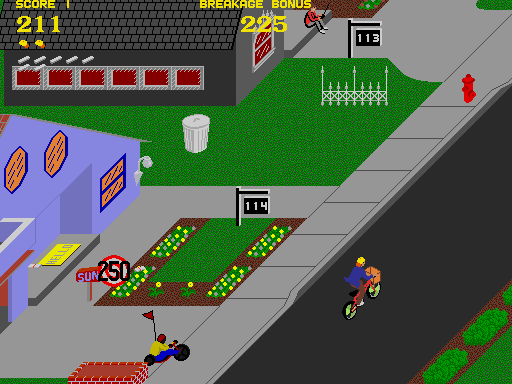
Alright, now we're talking. This is Retro Gaming people REMEMBER. No, really.

If you like Retro Gaming, just the mere mention of Paperboy has probably already got you humming the music in your head... I know I have. Aaargh, will have to go and play it. Now.
OK, had a quick game. Guess what? It's half the fun without the handlebars.

Alright, seriously now, this is one of those occasions where I think we have to stand in awe of Atari. Y'see, there's been many games brought out with kind of unique ideas, but they've never stayed that way. Here, with the exception of the hopeless home computer rip-off "Paperboy 2", I can't think of another game like this.
Here's the premise, on the surface it's very simple: Deliver newspapers to your customers, avoiding obstacles on the way. Now, you could take that as the be-all-and-end-all of it, but it's far from that simple.

First off, your customers. They all own nice bright houses, with big letter boxes. Deliver a paper to their door or their letter box to keep their custom. As Paperboys go, you're as lazy as they come, flinging the paper, America-style, whilst riding your bike down the street. Yup, none of this lark of riding your bike on one pedal and jumping off or even entirely by foot in the depths of winter, putting the paper through nicely like us harder, stiff-upper-lipped British Boys do, just simply pedal and pelt the papers, pulverising pugilists and pleasing your patrons, perambulating the pathway as you go.
 OK, now I've got that awful bit of alliteration out of the way (sorry, couldn't resist), I can get back to explaining the game. As well as customers, you have... that's right, non-customers. Did you see that one coming? They all own dark houses, many with gravestones in their front garden, and you can either simply not deliver a paper to them, or you can smash their furniture and/or windows and accumulate a "damage" bonus. Nice, huh?
If you manage to miss any customers along your way or damage their property, they will cancel their subscription. Lose ALL your customers and you'll get your P45 and Marching Orders, in other words "Game Over". Oh, and you have a limited supply of newspapers to throw, so don't get too happy with the fire button, although there are more you can collect.
In MAME, the game is best controlled with the mouse (although it's tricky), but in the arcades the cabinet had a set of handlebars mounted on the front, which were truly awesome. But the best bit of the game comes at the end of each day's round... the stunt course. Suddenly you are armed with an infinite supply of papers, which you can throw at the targets for big bonus points, whilst negotiating winding paths, narrow bridges and jumps. It's a bit of a change of pace, but incredibly good fun.

Once again, it's the "nice touches" that make this game so awesome. Some of the obstacles and bonuses you can score are normal everyday things, from the people driving cars down the street to the young lad with the remote control car, to cats and dogs, drunk pedestrians, unicycle-riding punks (erm?) and the naughty cat-burglar trying to break in a side-window. Most of these can be dealt with by means of high-speed Newspaper, but some have to simply be avoided. It's worth getting them with a newspaper though, for example there's often two men having a fist fight... hurl a newspaper at them to knock one out and the other raises his arms in victory. Nice.
One thing is for sure, if you spend 5 minutes on this game, you WILL be humming the music for the rest of the day. Gah, I'm STILL humming it now. Everyone around me wonders what the hell it is I'm singing.
Paperboy. It'll ruin your life. But you have to play it.

Tuesday, 6 March 2012

PC - Max Payne

PC 
Max Payne

Dark trenchcoats. Slow Motion "Bullet Time". Diving around shooting guns. What's that, you say? Sounds like The Matrix?

Hmm. I wonder if there was any inspiration there. To be honest, it's blindingly obvious, but fortunately what DIDN'T happen is that the resulting gaming experience was NOT in any way rushed out so much as to be an awful game. Almost unbelievably, I've got nothing but praise for what was basically a cash-in on a popular film licence.

No, I have to hand it to Remedy, they made a great game, with a great storyline, and here's the bit no-one will ever agree with me on... great voice-acting.

Alright, I know, everyone who looks at this game slates the voice acting, I just don't understand why. It might not be up there with the likes of the Uncharted series (Nolan North does have an incredible talent), but it's so far above, say, House of the Dead 2 on the Dreamcast it's not even funny. This is the thing, I suppose, it comes down to personal taste, and Max's dead-pan delivery is spot-on to me.

Anyway, enough of that, let's talk about the game now. To cut a long story short, Max Payne is an undercover policeman whose family are murdered by drugged-up thugs. As a man with nothing to lose, he's prepared to stop at nothing to uncover the secrets and lies behind the origin of the drug in question, known as V. Starting out among some of the less desirable of the criminal underworld, you slowly fight your way up the chain, discovering eventually that the whole dang thing is overseen by... well, I won't spoil that for you.

The gameplay itself takes a little while to get used to, but once you do, you'll be spinning and shooting your way in slow motion all over the place. Whilst as a 3rd-person shooter you can just run around and shoot your enemies, they're pretty accurate and have fast reactions, you're likely to die fairly quickly. You need to find cover and get the hang of diving out in Bullet-Time, aiming with the mouse, trying to get the crucial head-shot or enough body hits to drop the enemies. You may have 2 or 3 to aim at, so your reactions need to be quick. Accuracy will increase the amount of Bullet-Time you can use, and you can use your Bullet-Time whilst just walking around, but it runs out very quickly in that instance, so there's really not much point.

Weapons wise there's a good selection, several of which can be dual wielded, but my personal favourite is the Sniper Rifle. Aim at an enemy's head, and you're treated to a camera angle following the spinning bullet as it traces a path to the fatal impact. It's a gimmick, yes, but it works.

To be honest, this was probably one of the first "cinematic" games I really enjoyed. Cut-scenes and storyboards are part and parcel of games nowadays, and Max Payne used them EFFECTIVELY. Alright, graphics are much more sophisticated now, but we'd advanced from Quake and the idea of using the Quake engine to make movies, which, let's be honest... wasn't all that great.

Alright, so the game can get a little repetitive at times, but it was nothing short of superb. To keep you playing, there were several difficulty levels, which included a special difficuly called "New York Minute", in which you had a 1 minute timer to complete each level. Don't worry, you could earn extra time, but you were always up against it with that timer.

It's worth it, though, because, as a little bonus, hidden away at the end of the game is a version of the lobby gunfight from The Matrix... yeah, it's not exactly the same, but then again, with free level-design tools available on the internet, plenty of people made more accurate versions of that particular scene.

So there's a new Max Payne game coming out. Will I buy it? Maybe. Will it be as good as the original? Doubt it, but I hope so.

One thing's for sure, it's got a lot to live up to. If you haven't played the original, go and find it. Now.