Friday, 27 August 2010

Arcade - WWF Wrestlefest

Arcade
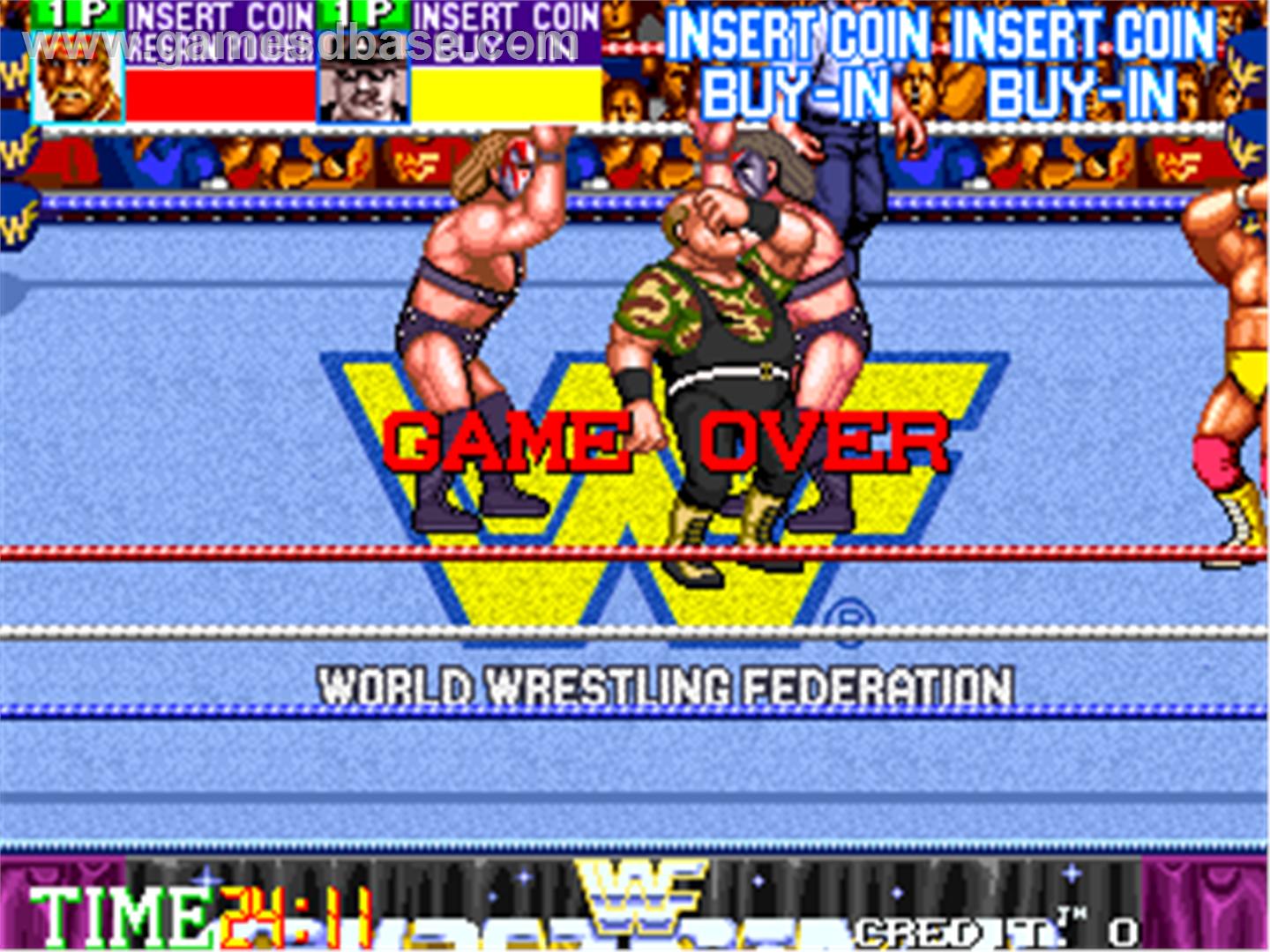
WWF Wrestlefest
Wrestling: Big men in tights and boots, pretending to kick the crap out of each other. Hear them roar in pain as a boot glances off their shoulder with a feather-light touch. See them glisten with sweat as they run from rope to rope, seemingly unable to stop running because they were Irish-whipped. See them land atop their opponent with what would be a devastating splash, if it wasn’t for the fact that they landed on their knees and arms first. Watch them fight in a pre-scripted battle of might and will.
I like Wrestling. Don’t get me wrong. It’s funny to watch, and for the most part is well delivered. Without the knowledge of the ring and the techniques used, you could be forgiven for thinking it’s real sometimes. Who can forget trying a Figure-4 Leg-Lock out and discovering it really does bloody hurt?

It’s known these days as “Sports Entertainment”, and is more about technique these days than the in-ring personas that it always used to be. Back in the days when the Undertaker was thought of as something invincible and Hulk Hogan was the Real American, wrestling was as much about ego and popularity.
It was the meteoric rise in popularity of WWF (now known as WWE thanks to the other WWF… confused? You will be) that prompted a stream of computer and arcade games dedicated to Wrestling, licensing the big names of the era. There had been a game already in the arcades, WWF Superstars, but when this one came out, it was enormously popular.

And deservedly so, because it’s one of the best Wrestling games of all time.
First off, I must point out that there’s ALWAYS the fundamental differences between Wrestling, REAL Wrestling (the ACTUAL sport) and Wrestling Video games. Real Wrestling is an Olympic sport, is very technical, and relies on real pain thresholds and endurance to determine a winner. However, it is devoid of storylines, egos, flashing lights and Pyrovogues. The more popular form of Wrestling, sometimes known as American Wrestling, is what you see on WWE/TNA etc. The moves aren’t meant to cause lasting pain or damage, everything’s scripted and pre-determined, and you can’t place any reliance on how things turn out being down to an individual’s skill. Look at Mr Script-writer in the office instead. However, it’s a spectacle of showmanship, and as such fantastically popular.
Video Games of Wrestling always take the best of both. Imagine combining the finesse and showmanship from American Wrestling with the reality of Real Wrestling… well, that’s what the Video Games always assume. Wrestling’s real, and all moves hurt and drain yours or your opponent’s vitality until one is so hurt/tired they can’t kick out of a pin by a 3 count, or are forced to submit to pain in some sort of hold.

Hold on, hold on… I’ve not explained this very well. All that is if you assume a standard match, of course. The game in question offers you a choice to begin with… Saturday Night’s Main Event, or the Royal Rumble.

Choosing the former allows you to choose a tag team from several different stars. Quite alarmingly, many of these performers are now dead in real life, for example Earthquake, the Big Boss Man, and Mr Perfect. There may be more…
Simple concept, take your tag team through 3 or 4 matches to win yourself a chance to take on the WWF Tag Team Champions, The Legion Of Doom… one of whom is also dead IRL now. Working as a tag team, only one of each team is allowed in the ring, however the other wrestlers may interject if a pin is made. With high energy levels, the chances of a wrestler kicking out of the pin is very high, however as energy levels deplete, the pinned wrestler may have to rely on his partner making the save before the 3 count. Alternatively, if energy levels are low and a submission hold is applied, there’s very little chance of avoiding defeat.

After a few successful victories, you then have to face Hawk and Animal, the Legion of Doom (or Road Warriors if you’re a purist) for the title, and believe me, their energy meters and regularity at winning the grapples make life very very difficult.
The grapples… of course… I should tell you the physics of the game… well, to be honest, they’re fairly random. You can punch and kick, however if you and your opponent get close enough, you’ll engage in a grapple. Button bashing will usually win this, bashing the kick button will normally result in an Irish Whip, bashing the punch button will perform a seemingly random move from the wrestler’s repertoire. For example, you might perform a body slam, or a backbreaker, or, if the opponent’s energy is getting low, you may perform your signature move, although some wrestler’s moves are performed on downed opponents only, for example Hulk Hogan’s leg drop or Earthquake’s sit-splash. Others you may even need to make your opponent run to the rope (Big Boss Slam, for instance).

You can always tell when your opponent’s ripe for a pin, they lie diagonally on the floor instead of horizontally. You will too, once your energy’s low enough. Keeping your partner on the side out of the ring for a certain length of time will cause him to “Power up” and get all anxious to get involved, like, giving a boost of energy too.
Another nice feature is that your wrestlers can “team up” at the tag, resulting in a nice easy way of keeping your opponent in your corner and draining his energy. Don’t expect it to work for a whole match, though.

And let’s not forget the Royal Rumble mode. This time you’re on your own, trying to pin or throw out your opponents to be the last man standing. A nice feature of this mode is that when a man is pinned, another wrestler can jump on top the pile to aid the pinfall count-out!

So the game’s entertaining, is there anything wrong with the game?
Well, now, that would depend on what type of cabinet you played the game. Unfortunately, the most common form of this game was the upright 2 player cabinet, thankfully with working speakers and the volume turned up (the thumping bass background track and the slightly grating voice synthesis do need to be heard for maximum effect, especially as the in-game commentary talks about every single move you do… for example “Warrior… Gorilla Press!”). However, with some searching you may have been lucky enough to find the 4-player buy-in cabinet, similar to the Simpsons or Teenage Mutant Hero Turtles cabinets (or even Gauntlet) that were commonplace. This meant you could have a proper 4-player Tag match or 4-players teaming up in a Royal Rumble, and really made the difference to the game.

The ONLY real problem was the big, chunky graphics. Whilst stuffed full of detail and character, they did sometimes get a little confused, and with the view being so zoomed in, an opponent sent to the ropes often ran off-screen to return, or even caused the screen to scroll slightly annoyingly, and the problem can be more pronounced in multiplayer as the game tries to keep all players on screen at the same time… But that’s a minor gripe, the game wouldn’t have been the same without it.
In summary, then, it’s one of the best executed wrestling games of all time, even down to the little things like the wrestlers looking tired and winded after a bit of punishment, there’s a steel cage match too. It’s well worth finding and playing, even if only through MAME. But if you’re really really lucky and you stumble across an original 4-player cabinet and you’ve a few friends in tow, that is certainly the best way to experience this game.

Friday, 13 August 2010

Old TV Shows - Knightmare

Old TV Shows
Knightmare
Who doesn’t remember Knightmare? Yikes, quite a lot of people. But those of you who do probably remember how ahead of its time it was. And if you were between the ages of 5 and 10 when it began, how scary it seemed at the time. Of course, now, when you’re fully aware of “virtual reality” and Chroma-key and how they work, then the magic is lost a little bit, but still, for its time, Knightmare was without doubt one of the best “gameshows” of all time.
So, let’s pretend you never heard of it, and give you a quick rundown. Knightmare was a quest-based “adventure” game show, where teams of 4 would take on the challenge to recover an object from a dungeon. The teams consisted of 1 “dungeoneer” and 3 advisors. The dungeoneer would be unable to see anything but directly beneath them thanks to a large “bucket” helmet placed over the head, so was very reliant on clear guidance from the advisors.

And the guidance did need to be clear and accurate, because this was an adventure with just one chance to win. The game was over if the dungeoneer was in a situation where they would have died in real life, or was captured.
Let’s get back to the beginning of it all, though. One of Knightmare’s main selling points, if you could call it that, was that the medieval dungeon theme was maintained from start to finish and helped along by a cast of characters and talented actors, the greatest of all being the “host”, the bearded Dungeon Master, Treguard, played by Hugo Myatt. He would introduce the show and compel you to return at the end, as well as distributing timely advice to the contestants.

“Welcome, watchers of illusion, to the castle of Confusion!” as Treguard would say. The very first show spent a good few minutes explaining the rules of the dungeon to the first team, who, it must be said, didn’t fare particularly well…

The rules were fairly simple. The only path is forward, there is no turning back, and you can only carry two objects at a time. There was a “time limit” of sorts, known as the “Life Force”, an animated face that slowly fell to pieces, which could be restored by picking up food (and then placing this in the knapsack, where it was “consumed”). This represents one of the most iconic features of Knightmare, and I was greatly disappointed when they decided to ditch it in favour of a walking suit of armour or even a pie.
Once in the dungeon, which in reality was single plain room onto which Chroma-key technology was applied, the “Helmet of Justice”, or “Bucket” as it was often known, ensured the dungeoneer was solely reliant on the advisors to avoid danger, and also ensured a few amusing deaths along the way.
Amusing deaths… I don’t want to offend anyone, death is probably one of the least funny things in the world, but akin to Mortal Kombat, the moment a quest is put to an end brought a strange sense of satisfaction, especially when a team was so SPECTACULARLY poor they directed them straight into the obstacle they were trying to avoid!

Quests normally followed a simple 3 level system, each level consisting of an entrance (sometimes a choice to be made here), a few “obstacle” rooms (either good guidance or a puzzle to solve to progress), a clue room (objects and/or magic to be gained to aid progression in a later room) and a well room (down to the next level). Objects, knowledge or spells gained from the clue room may be needed to defeat an obstacle later in the level.
The clue rooms themselves required some effort to pass successfully, as usually there was a guard (most often a “wall-monster”) who would ask riddles. The more correct answers, the better the chances of survival overall.

Supported by a cast of about a dozen, including characters such as Merlin the wizard, Casper the talking key, the savage Goblins, Cedric the monk and Folly the Jester. More characters appeared in later seasons, including assistants for Treguard (Pickle and Majida), Hordriss the Confuser, Lord Fear, Sylvester Hands and Snapper Jack to name buy a few.

The real stars, naturally, were the bad guys. Mogdred and Lord Fear were excellent at actually striking fear into the hearts of ourselves as watchers and the dungeoneer and advisors too. But still, I just keep coming back to the deaths.
It’s worth mentioning the amusing tale of Mary Whitehouse, who was told there was a new gameshow where they killed children, which of course shocked her. Of course, add in the fantasy factor, and it all becomes acceptable again.

But that doesn’t change that some of the deaths were exceptionally violent. Some met their fate in one of the “bomb rooms”, where a large bomb would light and consequently explode if the dungeoneer wasn’t quick enough to get out. A lot of deaths were due to poor navigation (straight off a cliff, or rather memorably, the fall down the “Block and Tackle” room… “Sidestep left… I MEAN RIGHT!”), but who can forget the times we saw the “Corridor of Blades” claim a victim?
 Oh. The same people who CAN’T REMEMBER KNIGHTMARE.

No matter. Despite changes to the structure of the dungeon and indeed the game. (introducing corridors, the Eye Shield and outdoor locations, changing the Life Force sequence and even the Helmet of Justice, and the awful idea of the Reach Wand), Knightmare will always have a special place in my memory. Probably the best part of all is that no-one ever decided that the game was “too hard” after there were no winners in series 1. Whilst there were winners, there were very very few of them, so winning really was reserved for the elite.

You know, there’s so much to Knightmare, really I can’t mention everything in one review. It’s not possible. Also, it would be fair to say my opinion of Knightmare depends very much on what series we’re talking about. I wasn’t keen on the final seasons, even though there were obvious graphical improvements, I never really liked the Eye shield and taking the quest outdoors. I liked the computer generated and hand painted rooms used in early seasons. But there were certain characters from later seasons who I liked, too. I haven’t even touched on spell-casting, needless to say spells were only given when they were going to be needed shortly afterwards.
Whilst Knightmare makes very rare appearances on channels like Challenge on Sky, if you want to sample the joys of this 80s/90s wonder you would be much better finding someone who can supply recordings seeing as there appears to be no official release lined up.

Alternatively, there are MANY images and clips from the show available from www.knightmare.com, as well as details of every single quest (the participants, the rooms visited, how they fared and so on).

Get on over there now if you want a quick sample of the best of Knightmare, and if you find you want to see how a full episode or even series panned out, get on the forum and make contact with someone.

According to Channel 4, Knightmare was chosen by the public as the 17th greatest Kids TV show of all time, which is pretty good going when you consider some of the shows it was up against.
For me, it’s right up there at number 1. Just a shame the official game wasn’t anywhere near as good…

On a final note, Knightmare fans might like to check out Fresh Love’s tribute to Knightmare, Bad Dreem, “where all your dreams become baaaaad.”

WARNING TEAM! TEMPORAL DISRUPTION IMMINENT! Oh dear… Temporal Disruption complete… Phase with us once more, and just keep telling yourself, it’s only a game… isn’t it?

Thursday, 12 August 2010

ZX Spectrum - Kane

ZX Spectrum
Kane
In the days of the Spectrum, when you were limited to 48 KILOBYTES of memory (less when you take reserved areas of memory out of the equation), making a game within such a constraining amount of memory was an achievement on its own. Making a game with 4 distinct sections was even more of an achievement, and then to deliver them without the need for “multiload”? Unthinkable!!!
But back in the good old days Mastertronic did exactly that. “Kane” was the name of a town in the old Wild West, and it was there that you, as a cowboy of some description, decided to head, for whatever reason. First you have to get there, so along the way you decide to shoot some pigeons with a bow and arrow.
Using a set of crosshairs, simply take aim and fire, not forgetting to lead the pigeon by a suitable amount. Every time you hit one, you’ll get your arrow back, and every 3 pigeons will award you an extra life for the next sections. Once you’re out of arrows (or miss enough pigeons), the level will end and off you head towards Kane.

The next sub-game, the Ride to Kane is a horseback ride to the town. Along the way you must jump over giant lettuces and prickly bansai trees lest you be pitched head-first off your horse at the cost of one life.
Once you reach Kane, it’s straight into a Shoot-out. The bad guys will pop out from behind their hiding places and take pot shots at you, whilst you must shoot enough of them to progress to the final stage. This level is very much like a primitive version of Cabal, only not so easy to dodge the randomly fired shots.
To finish off is the very difficult challenge of the Train Chase. This is another level like the Ride to Kane, except this time you’re trying to catch up with the front of a runaway train. The obstacles are diabolically placed to cause maximum upset. The thing to remember on this one is that running at medium speed will only keep you level with the train, you have to run flat out to gain on it. I never quite managed this (I did come close a couple of times), but then this is how it should be, completion of a game is for the elite, not everyone like it is these days with our “interactive movies”, which are used as a sorry excuse for “games” these days.
One of the best features of this game is the graphics. Barely any colour clash, superb fluid animation, and attention to detail, as well as the famous parallax scrolling.

Thanks to the wonders of emulation, there’s no reason why you can go and play this in the next few minutes. The World Of Spectrum archive is your friend…To be fair, at the time of release the game was widely panned, but I liked it, and that's all that matters to me when I write reviews. Maybe you'll only play it once. I played it plenty more than that.

Nintendo 64 - Goldeneye

Nintendo 64
Goldeneye

Ssssh. Calm down. I know, it’s difficult not to mention this game without feeling a trembling of excitement, even now, but we’ve got to try and be sensible about this. It’s a game, an old game by today’s standards and nothing more.

WHAT??!? AN “OLD” GAME??!? ARGUABLY THE MOST DEFINING MOMENT IN FIRST PERSON SHOOTER HISTORY, AND YOU REFER TO IT AS NOTHING MORE THAN AN “OLD” GAME???!

Cripes, my split personality has decided to grace me with his presence for this review. And for once, I have to agree, he’s got a point. I can’t remember a game before Goldeneye where the enemy reacted so realistically. Except maybe Hitman:Codename 47.
BUT THIS CAME OUT YEARS BEFORE CODENAME 47 GRACED OUR SCREENS WITH HIS BARCODED BONCE!

Yes, this is true, hence Goldeneye was years ahead of its time. If I could be allowed to continue without such frequent interruption? A nod will suffice…

Right, so in a big step away from the old formula of James Bond games (which, if memory serves, Gremlin Graphics had the rights to them all and were supposed to be releasing them at a rate of 1 a year), Rare brought us this frankly staggering epic for the Nintendo 64, and boy was it popular among both the casual and hardcore gamers alike…
CASUAL AND HARDCORE?

Ahem. Yes. In a bold progression in FPS history, Goldeneye dropped you into the world of James Bond, a world made up of polygonal enemies with texture-mapped faces, a high frame rate and amusing animation, half-decent enemy AI, and oodles of fun. With the 4-player split screen multiplayer mode, much fun was to be had sniping and killing your friends, but it’s the single-player game that worked so well on its own that helped in the quest to be a massive hit.
Let’s be honest, the one thing above all else that let down the FPS genre was a distinct lack of intelligence on the part of the enemy. It’s why online FPS games have been so popular, the skill of humans tends to be infinitely higher than that of any complex algorithm used to aid the computer-controlled enemy. Although much has changed since then, and things are undoubtedly much better now, Goldeneye paved the way forward with enemies that react more realistically than had ever been seen before.

TALK ABOUT THE STEALTH! TALK ABOUT THE STEALTH!

Alright, yeah, I’ll get to that now. Without a shadow of a doubt, the highlights of the piece were the stealth sections. There weren’t many, but it was very often better to creep along and not disturb the guards instead of charging in all guns blazing. In fact, for some levels, it was essential. Getting into a firefight, especially on the harder difficulty levels was not a sensible option.

Whilst we weren’t talking Metal Gear Solid levels of stealth, we were talking the kind where silenced weapons wouldn’t disturb a man from his duties. Memorably, climbing through a vent into the toilets on mission 2, and shooting the guard in the head, only to find you’d actually just shot his hat off, and he hadn’t noticed! Now that’s stealthy…

NO GAME’S PERFECT! STOP GIVING GOLDENEYE A HARD TIME!

Whilst Goldeneye had a lot of things, well, not exactly WRONG with it, but you know what I mean… There was a hell of a lot more right with it. But I’ll tell you what really hit the mark for me… after you complete the game, on a hard enough difficulty level, you open up a couple of extra missions. With the addition of Moonraker Lasers and the Golden Gun, these are a fitting tribute to James Bond movies as a whole, not just Goldeneye. But the ultimate moment was the unlocking of 007 mode.
Basically you could play the game completely customised according to how good you thought you were. Sliders allowed you to completely customise the accuracy, health and awareness of the enemy, and this resulted in being able to set yourself a whole new challenge. If you found the game a bit too easy in the main (There’s a good challenge there, sure, but if you complete it, then surely you need to make it slightly harder for the next time?) notch up the challenge a little bit with some improved accuracy or enemy health.

WOW! THAT SOUNDS LIKE AN AMAZING FEATURE! WHY DON’T MORE GAMES FEATURE THIS STROKE OF GENIUS?
Do you know, I really don’t know. And for what it’s worth, the other cheat modes that can be activated are genius too. To unlock them you have to complete missions within a time constraint and on a certain difficulty level. Some of these are especially difficult to achieve, but so worth the effort, especially the cheat that gifted you all available weaponry. Whilst you could carry an impossible amount of arsenal, the varied range available is very impressive and a lot of fun. The weaponry cheat also revealed a few weapons that you wouldn’t otherwise see (for example the standard shotgun, or taser)

HAVE YOU EVEN BEGUN TO TALK ABOUT THE GAME YET???

Well, no. Not really. Most of the game follows the plot of the film, although there are a couple of unrelated missions (the excellent Frigate mission, for instance). Each mission contains several objectives that must be met, on the harder difficulty levels there are usually more objectives to complete. For some, stealth is the order of the day, for others there’s the chance to get involved in a bit of an altercation, but one thing is for sure, you’ll need to make sure you’ve got some cover if you want to survive the harder difficulty levels.

These days, the game probably does look a little dated. But it has to be said, the game stunned the gaming press at the time, and even now it’s considered one of the benchmark titles. Hence the impending re-release of the game (in enhanced form) on the Nintendo Wii.
CRIPES. HOPE THEY DON’T F*** IT RIGHT UP.

We shall have to wait and see. I don’t know how they can make a mess of it, the winning formula is there, it just needs bringing up to date. And the multiplayer taken online.

But still, you should play the original, see where the FPS as we know it finally came of age, with serious and realistic graphics, serious gameplay, and serious amounts of fun.

I’M OFF NOW. GOODBYE.

Thank God that’s over.

Wednesday, 14 July 2010

Arcade / Sega Saturn / Dreamcast - Daytona USA

Arcade & Sega Saturn & Dreamcast
Daytona USA
Doo do-doo doo doo doo doo doo dooooo doooooooooooooo…. DAYTONAAAAAAAAA!

If you visited arcades in the late 90s or early 2000s, you couldn’t help but notice the enormous quantities of racing games arriving, mainly “front of house”. You couldn’t go by without coming across a Manx TT, Sega Rally or a Daytona USA, and many arcades involved themselves in a “willy-waving” contest by trying to have the biggest Daytona USA setup they could.
Yep, this was a racing game with the potential to daisy chain together several units, as well as other optional extras. I recall visiting Newquay and the excellent Carousel amusements on 3 consecutive years to find they’d added another 2 Daytona seats each time… However the top prize had to go to Mr B’s in Blackpool, with a 4-player setup with the addition of cameras pointing into each players’ face and a big screen over the top showing the race along with the faces of the competitors.
At a standard rate of £1 a race (and often a race consisted of 8 laps of less than 20 seconds each), this game was unsurprisingly the highest grossing arcade machine of all time. People rarely ventured from the Easy level (777 Speedway, basically a big oval with long sweeping curves), as the other tracks were far more difficult, and not suited to multiplayer so much.

The big puller was the graphics, they did look amazingly realistic, but most arcades had the volume turned up too. This was a bonus as the music really was superb, from the theme tune (see the start of this review) to the familiar war cry of “ROLLING STAAAAAAAART!”, the music is so good I have the soundtrack in the car for long distance driving.
As far as longevity goes, this game really doesn’t have any. There’s only 3 tracks, and whilst there’s plenty multiplayer fun to be had, Single player gameplay is decidedly limited.

So, was bringing the game to the home console market a good idea? Well, the Saturn versions (yes, there was two of them) didn’t quite cut it visually, plagued with clipping, pop-up and a lower frame rate. Gameplay wise, they weren’t so bad, the action was still fast and handled very much like the Arcade Original. But was one player racing any good?
Not really, especially with a title like Sega Rally around (which was REALLY good). Even in Endurance mode, trying to squeeze playability out of the game without getting repetitive was an impossible task.

During this era, driving games suddenly improved, but got much smaller and shorter. Prior to this, driving games at home boasted huge numbers of tracks, or at least that was the primary selling point. For example, Network Q RAC Rally came out with around 30 tracks available. All of a sudden racing games were cut to 3 or 4 tracks but vastly improved physics and graphics. Fine for the arcades and the quick, sharp burst of fun, but not so good for a game you’re expected to pay £30 or more for at home where most play is by yourself. Until the advent of online gaming, this kind of racer signified to me both the high point of arcade racing experiences, and the low point of the home racing experience.
Daytona’s success will guarantee its deserved place in the annals of history, tarnished only by comparatively poor home versions. What I do hope will live forever is the awesome music.

Blue, blue skies I see...

Wednesday, 7 July 2010

Arcade - Crime City

Arcade
Crime City
I’m going to keep this short and sweet here, because the best thing you can do to get to know this rare little gem is read Lord BBH’s review. Be warned, there is some colourful language in there, but that doesn’t detract from what is an excellent and hilarious read.
All I will say is that this game, which follows a formula based on Rolling Thunder / Sly Spy / E-Swat, is littered with Japlish / Engrish, and as a result you spend the start of each level wiping the tears of laughter from your eyes. The game itself is decent, but not exactly all-time-classic time-enduring quality material.
While you’re at it, you should take the time to read the rest of Lord BBH’s reviews, there’s some interesting and well-written material in there, and if you’re a fan of sarcasm you’ll be on cloud 9…


Well, go and read it for a kill time.

ZX Spectrum - Barbarian

Sinclair Spectrum
Barbarian
(I know it's the Commodore 64 box, but the art's the same. See that man? That's Wolf from Gladiators, that is...)


Harking back to the days of Mortal Kombat, where death-moves were really taking off and violence in video games was almost a necessity, blood and guts were a staple of the modern era of gaming. This has continued somewhat as more and more games receive age rating certificates akin to Hollywood movies, games become more realistic and immersive… but back in the “Good old Days”, when everything was made of wood, a game with shock value often found itself on the receiving end of more unfavourable press than Saddam Hussein buying his horde of PS2s to control his war machine.
 Such a game was Barbarian, a straight one-on-one beat-‘em-up on the humble 8-bit Spectrum. Whilst sword-fighting was nothing new, the sheer number of moves and combinations used on your humble joystick represented a huge technical battle against some of the tougher AI in the game. But it was the violence that really stirred things up. Some of it comic violence, like the way the little Gremlin would come across the screen to drag away the dead man’s carcass, but the ultimate triumph (or tragedy if you were on the receiving end) was the spinning neck chop. Whilst most fights were won and lost by the process of draining your opponent’s energy, you could cut a fight short by simply decapitating him with this move. Usually the first 2 opponents were easy enough to hit with this manoeuvre, after that it was nigh on impossible,

Amusingly, the gremlin that collects the dead body will kick a loose head along the floor, probably just as disturbing to the death blow just dealt, but in the mid to late 80s this was like heaven to any teenage (or pre-teen for that matter) boy.
 Unfortunately, this is pretty much it, 8 fights of increasing difficulty, followed by the final showdown with the evil Drax, who, by the way, once you’ve figured him out, is exceptionally easy to beat. But the combat system is very thorough, with lots of moves to choose, using a tried and tested system similar to Way Of The Exploding Fist, so whilst the 8 fights can feel very samey, they’re a challenge for sure, and to win them all requires some skill and smooth moves. The “rolling knock-over” attack is a bit of a cop out, but once you get the hang of jumping, blocking and retaliating with a variation of moves, you’ll be looking pretty impressive, especially if you manage to land the fatal head-lopper in the process.
On the plus side, there is a two player mode, so you can decapitate all your friends. Video game violence had never been so much fun. And until the dawn of Mortal Kombat, this was definitely the place to dispense that pent-up aggression.